News
We’ve entered the era of AI-accelerated attackers and agentic attacks.
Outpacing AI means detecting and disrupting threats before they can execute and spread.
In the age of AI-powered attacks, dwell time is the difference between stopping a threat and facing a breach. As attackers compress the attack lifecycle from hours to minutes, speed isn't optional, it's the only lever you have.
That’s why we’re so proud of our ability to contain threats in real-time and report on those threats in a median time of 18 seconds. This gives clients a clear advantage, surfacing malicious activity on the endpoint in seconds and broader threats in minutes, so they can be contained before they spread.
Evaluating speed in MDR can be confusing. Metrics like MTTD, MTTR, and MTTI each offer different insights, but don’t always tell the full story.
Vendors often report MTTR starting from when an alert is escalated to an analyst, not from when the attacker first moved. That gap can be hours and is where attackers build momentum.
Without that full picture, speed becomes a surface-level metric, not a true measure of security effectiveness.
Field Effect was built to operate at the speed and scale of modern attackers by combining AI with the tradecraft and experience of our expert-led SOC. The result is reduced attacker dwell time and industry-leading speed across the full detection lifecycle.
Field Effect blocks malicious processes, including ransomware and malware, directly on the endpoint using context-driven analytics, disrupting the bulk of threat actors in as little as milliseconds.
While threats are blocked in milliseconds, endpoint AROs are published to client portals in a median time of 18 seconds, while more complex, cross-environment and multi-sensor attacks are detected in a median time of just 12 minutes.
93% of threats are investigated and reported automatically. When expert investigation is required, our SOC rapidly triages and escalates real threats without getting slowed down by noise, resulting in a 2.6-minute MTTI.
Together, these capabilities ensure threats are not just detected quickly, but understood and contained before they can escalate.
Field Effect’s performance is the result of intentional design, built from the ground up for real-time detection and containment.
Field Effect uses a Federated Smart Compute model designed to stop threats as they happen. Instead of sending telemetry to a centralized data lake, we execute analysis as close to the event as possible, reducing the need for data transfer and eliminating latency.
At the endpoint, threats are blocked and contained in real-time. When deeper analysis is required, signals are rapidly correlated across the environment to detect broader threats and surface meaningful insights for investigation.
The expertise, tradecraft, and judgment of our SOC analysts, most of whom are former intelligence operatives, is purposefully combined with AI, enabling our platform to investigate threats the way an experienced analyst would.
The result is precise, high-confidence detection that keeps pace with the speed and scale of AI-powered attacks. This frees our SOC experts to focus on the most sophisticated threats and continuously feed insights back into the platform.
AI isn’t an add-on at Field Effect—it’s foundational. Our MDR solution was built from the ground up with AI at its core, enabling us to cut through noise and surface only the most critical signals.
This empowers our SOC to focus on what matters, while continuously improving the platform through real-world insights.
AI-powered attacks move fast, and a delay in detection is where they win.
Field Effect eliminates that advantage—detecting and disrupting threats in seconds, not hours, so they can be contained before they spread. Because speed isn’t optional. It’s the difference between control and compromise.

Tour the portal
Want to see what drives Field Effect MDR’s industry-leading threat detection and performance?
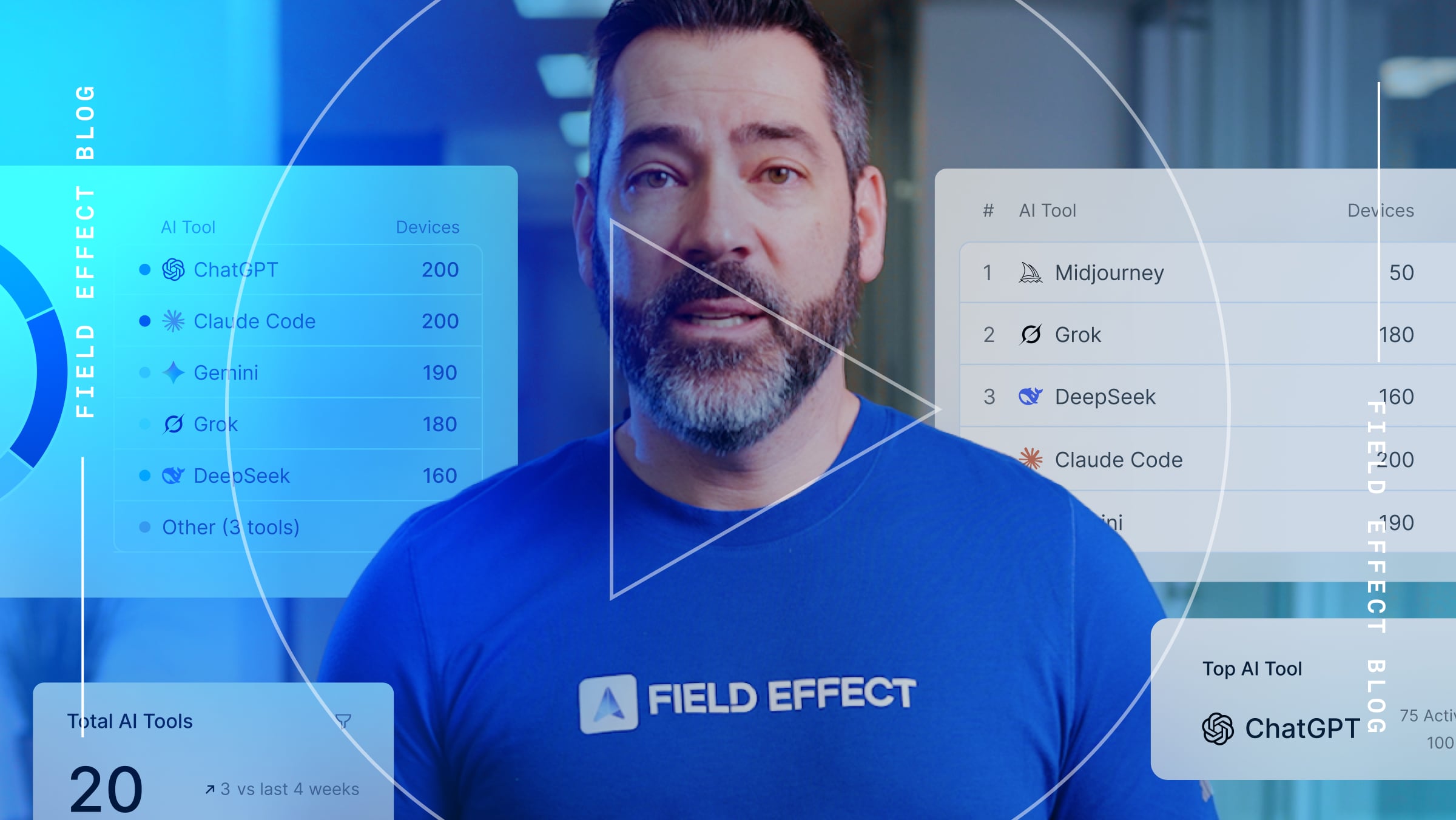
Watch this three-minute demo video to learn how threats are detected and contained in seconds, before they have time to spread.
Field Effect's median time to detect measures the time between a security event and when an ARO is published to a client portal. Field Effect MDR detects and reports endpoint threats in a median of 18 seconds. More complex threats that span multiple threat surfaces and sensors are surfaces in a median of 12 minutes, helping reduce attacker dwell time.
Field Effect investigates escalated threats in a median of 2.6 minutes. In addition, 93% of legitimate threats are investigated and reported automatically, reducing response time and analyst workload.
Yes. Field Effect blocks malicious processes, including ransomware and malware, directly on the endpoint in real time—often in milliseconds—to disrupt threats before they can execute and spread.
Detection speed is critical because AI-powered attacks can move quickly to create disruption. Faster detection and investigation reduce the time attackers have to escalate privileges, move laterally, and cause damage, helping organizations contain threats earlier.
Field Effect uses a Federated Smart Compute model that analyzes activity as close to the event as possible. This reduces latency, eliminates reliance on centralized data processing, and enables faster threat detection and disruption.
Many traditional MDR solutions collect and transmit endpoint data to a centralized cloud for analysis. This process introduces latency, as data must be transferred, processed, and analyzed before action can be taken. As a result, detection and response can be delayed, giving attackers more time to move within the environment.
Field Effect combines real-time endpoint disruption, Federated Smart Compute, AI-native detection, and an expert-led SOC to deliver fast, high-confidence detection and investigation across the full threat lifecycle.
Yes. Field Effect MDR is AI-native, meaning AI is built into the platform from the ground up. This helps reduce noise, prioritize meaningful signals, and accelerate threat detection and investigation.
Organizations should evaluate MDR performance across the full detection lifecycle, including detection, investigation, and response. Looking at a single metric like MTTD or MTTR alone may not reflect how quickly threats are actually identified and contained.