Blog Post
In cybersecurity, alert fidelity is essential to enabling fast, confident response. Duplicates, low-value signals, and false positives create too many alerts that waste time, burn out teams, and increase the risk of missing something critical.
The goal isn’t simply “accurate” alerts. It’s noise-free, decision-ready reporting: the right finding, at the right time, with the context needed to act.
That’s why Field Effect delivers high-fidelity alerts without the noise.
Many vendors tout low false positive rates. But there’s a difference between “error-free” and “noise-free.”
Even technically accurate alerts can create fatigue when they arrive in overwhelming volumes, repeat across tools, or lack the clarity needed to drive action. Instead of accelerating response, noisy alerting pulls teams into time-consuming triage. Time spent chasing down “maybes,” stitching together fragmented evidence across systems, and determining root cause, scope, and impact.
The downsides compound quickly:
Slow recovery times as analysts work the queue instead of remediating threats
In short: accurate alerting which reduces false positives is important, but it’s not enough. What matters is delivering decision-ready findings so teams spend time on alerts that matter.
Alert fidelity means the alerts you do receive are consistently relevant, actionable, and easy to prioritize. This way, teams can respond quickly without needing to reconstruct the story from raw telemetry.
High-fidelity alerting should:
Prioritize actionability over volume. Alert only when there’s a clear security decision to make or action has been taken; suppress or de-prioritize non-actionable signals; consolidate repeats into a single issue when possible.
Field Effect replaces noise and complexity with crystal-clear insights.
Users only receive Action, Recommendation, and Observation (ARO) alerts when action is truly required. From collection to publication, our process filters out 99% of alert noise, helping save valuable time and minimize disruption.
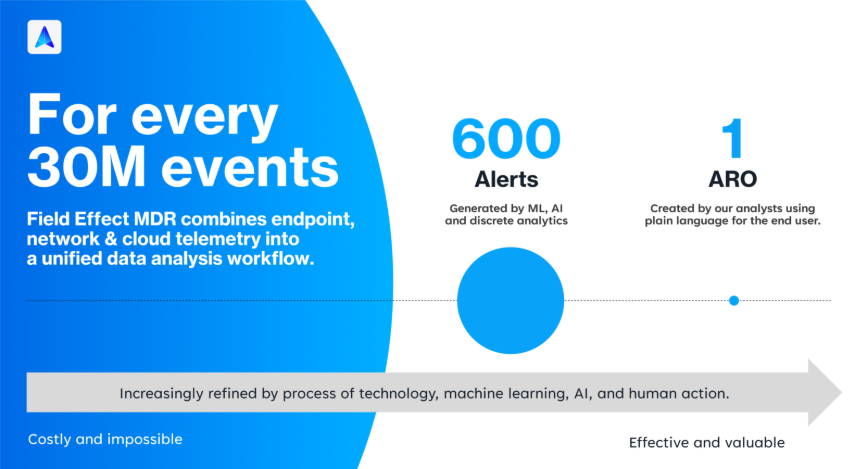
Field Effect’s ability to reduce noise is tied directly to the way we’ve built and continue to evolve our cybersecurity platform.
Many MDR providers assemble their service by managing or acquiring third-party tools. That can create a siloed approach that delivers blind spots, and fragmented workflows across products.
When telemetry lives in different places and follows different formats, it’s harder to correlate activity across the environment. This negatively impacts alert fidelity, resulting in more duplicate notifications, false positives, and time spent troubleshooting and stitching context together.
Field Effect took a different path.
We built Field Effect MDR from the ground up to provide a true single pane of glass across the environment. Owning the full stack gives us end-to-end visibility into the behaviors we monitor, consistent enrichment and correlation, and the ability to evolve detections quickly as threats change.
This allows our security operations center (SOC) to focus on what matters. We identify meaningful indicators of attack and translate complex signals into actionable guidance, instead of pushing unnecessary noise to lean IT teams and MSPs.
Accurate alerts still create fatigue when they arrive in high volumes without context. That’s why Field Effect focuses on clarity, not count.
Wherever we can, we collapse related signals into a single ARO without adding risk.
For example, if we find an end-of-life operating system across dozens of endpoints, you get one ARO with the scope and recommended action, not dozens of repetitive notifications.
Behind the scenes, our analysts still review the full picture: for every ARO published in the client portal, we evaluate roughly 600 underlying alerts (low-confidence signals, anomalies, and indicators) that are meaningful to our SOC, but often noisy or ambiguous otherwise.
For Field Effect MDR Complete customers, our SOC continuously monitors that background alert stream for early signs of attack and performs targeted threat hunts when risk is identified. When warranted, we publish a supplemental, analyst-written ARO that summarizes what matters (impact, root cause, and next steps) in jargon-free language.
This approach delivers enterprise-grade protection without overwhelming lean IT teams: you see what’s relevant and actionable, while our SOC handles the triage and containment work. And if you do want to dig into the underlying data, it remains available in the appliance dashboard.
There has been a clear uptick in the use of “AI” in cybersecurity marketing. And where AI (more specifically machine learning) has empowered rapid, scalable threat detection that would otherwise not be possible, it's not without limitations.
Machine learning is excellent at identifying known threats. It can parse through events at scale to identify specific tactics and techniques that may otherwise go unnoticed. However, it fails to apply context such as what normal behavior might look like for a client.
This means vendors who over-rely on machine learning or “AI” will inevitably deliver a lot of noise and false positives, and struggle to differentiate the presence of certain tactics as being normal or abnormal given a certain environment.
Field Effect delivers our promised high level of fidelity alerting thanks to our unique combination of machine learning with advanced analytics and human intelligence.
The use of advanced analytics allows Field Effect to extend the expertise of our analysts into our automated detection and deliver high precision alerting, at a scale that would not be achievable with analysts alone. Our analytics engine can eliminate false positives, without requiring intervention and flag analysts when needed. This allows our expert-led SOC to focus their attention where it's truly needed: threat hunting, identifying zero days, supporting clients, and building intelligence back into the platform.
Even the highest-fidelity alerting generates noise if detections aren’t tailored to your unique environment. That’s why Field Effect continuously tunes analytics based on historical activity, observed baseline behavior, and client feedback. Plus, clients can work with our analysts to mute or alter specific analytics when appropriate.
By establishing a baseline for expected behavior, we can differentiate harmless anomalies from true risk, ensuring detections remain both precise and relevant while minimizing unnecessary noise.
For example, in most cases, high-volume data transfers are a clear indicator of data exfiltration. But if a specific organization or user regularly performs large transfers as part of normal operations, Field Effect suppresses transfers below the expected threshold and only alerts when activity becomes genuinely anomalous.
Clients can help refine this baseline over time by dismissing alerts, strengthening their environment profile and further reducing noise in the future.
Lean IT teams often struggle to balance everyday operations with growing security needs. Field Effect MDR has become a standout option for organizations that want strong protection without the burden of sorting through endless alerts.
Here’s how real users describe the difference.
Field Effect delivers only relevant, high-fidelity alerts tailored to each client’s environment and user behavior. Every alert includes full context and step-by-step remediation guidance so teams can focus on resolution instead of triage.
Instead of noise and false positives, teams receive validated, actionable insights. One mid-market account manager highlighted this benefit directly: “The alerts that come through are meaningful, contextual, and actionable—it feels designed to help teams respond, not just react.”
This approach helps lean teams focus on resolution, not filtering.
One of the most praised aspects of Field Effect MDR is its alerting model. Using AROs, the platform delivers prioritized alerts with clear context and next steps. As one customer put it, “Getting notifications and alerts that actually mean something.”
Rather than sending raw alerts, Field Effect delivers AROs that clearly explain what happened, why it matters, and how to respond.
One technical services manager said that they "find the ARO very valuable," noting they now catch outdated software, CVEs, and agent gaps they previously missed.
For organizations without dedicated security staff, Field Effect MDR acts as an extension of the team. With 24/7 monitoring by experienced analysts, threats are detected, validated, and escalated in real time. One IT leader summed it up clearly: “It’s like having a security department without actually having one.”
Yes. Customers consistently highlight the clarity of ARO explanations, making them accessible for L1 technicians and IT administrators who manage security alongside many other responsibilities.
“Even complex findings are presented in a way that makes sense," said one user, making Field Effect MDR ideal for IT teams that manage security among many other competing responsibilities.
Alert fidelity is what determines whether MDR speeds up response and containment, or slows it down. When teams are buried in duplicate alerts, low-value signals, or unclear escalations, the real cost isn’t just time. It’s delayed containment, missed priority events, and burnout across already-stretched IT and MSP teams.
Field Effect is built to solve that problem. Instead of sharing an overwhelming volume of alerts, we correlate what matters, and surface AROs that are decision-ready: clear, prioritized, and grounded in context. You get the “what happened, why it matters, and what to do next”.
The result is enterprise-grade protection without enterprise-grade overhead: fewer distractions, faster confidence, and a security operation that stays focused on outcomes—detecting, containing, and continuously improving—rather than managing alerts.