Blog Post
Last updated: May 29, 2026
SentinelOne’s Singularity platform and Vigilance MDR service are widely recognized.
Many MSPs, lean IT teams, and mid-market organizations explore alternatives to SentinelOne Singularity and SentinelOne Vigilance MDR when the operational demands or pricing complexity exceed what they can support.
Common reasons organizations look beyond SentinelOne:
These challenges often push buyers to consider MDR solutions that provide more simplicity, clarity, and predictable value.
A strong SentinelOne alternative provides full-environment visibility, clear and actionable alerts, and predictable pricing—without the modular complexity.
Field Effect MDR provides unified protection, expert-led monitoring, and clear, actionable guidance—without multi-module complexity.
Field Effect delivers enterprise-grade protection across endpoints, networks, and cloud services in a single, integrated solution. No bolt-ons or separate contracts required.
A highly skilled SOC—staffed by elite analysts including former intelligence professionals—proactively hunts, investigates, and responds to threats around the clock.
AROs (Actions, Recommendations, and Observations) provide crystal‑clear, context‑rich, and actionable guidance—distinctly easier for IT teams to use than generic alert streams.
Field Effect’s MITRE Engenuity ATT&CK® Managed Services Evaluation results demonstrated:
Field Effect delivers frictionless deployment with minimal required configuration, including plug‑and‑play appliances, click‑to‑enable cloud monitoring, and standard installers for Windows, Mac, and Linux enable deployment in days, not weeks.
Straightforward per‑user pricing with key features built-in, including vulnerability management, dark web monitoring, Suspicious Email Analysis Service (SEAS), DNS firewall, and flexible log retention options.
Designed for MSPs: L1‑friendly usability, PSA integrations, multi‑tenant workflows, partner‑centered support, and co‑marketing resources.
Field Effect MDR outperforms industry leaders like SentinelOne, delivering a premium MDR solution without the premium price.
SoftwareReviews Report
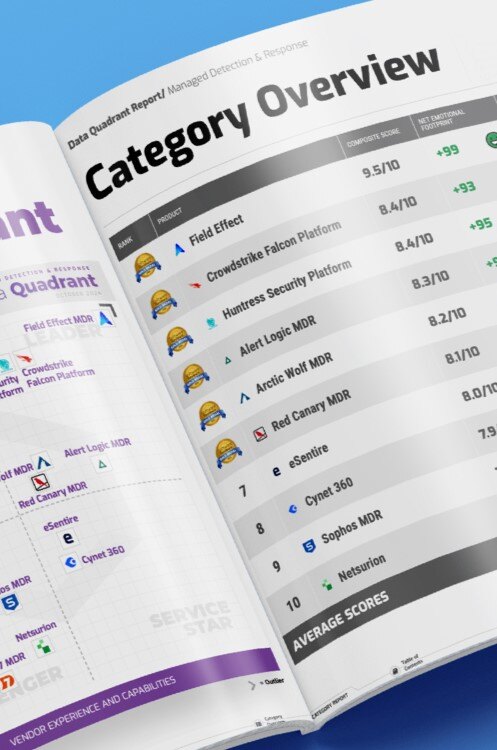
Download the 2025/2026 MDR Data Quadrant Report, the industry's most robust MDR benchmark, based on feedback from 423 verified users.
You'll see why Field Effect has ranked as a premier solution for four years running against SentinelOne, CrowdStrike, and Huntress.
SentinelOne Singularity is an endpoint‑led technology stack (EPP/EDR) with optional modules for identity, cloud, and data lake/analytics.
On its own, teams typically add an MDR with a “bring your own endpoint agent” model to run 24/7 operations. Blackpoint, for example, is a common choice layered on top of Singularity instead of Vigilance.
SentinelOne’s managed service layer for customers who want SentinelOne’s SOC to run Singularity 24/7. Coverage depth still depends on which Singularity modules are licensed and integrated.
Field Effect MDR is a unified platform + 24/7 SOC in one offering. In practice, Field Effect can replace what buyers try to assemble with Singularity and Vigilance (or Singularity and Blackpoint), but with less complexity and clearer alerts.
Field Effect MDR has its own proprietary endpoint agent baked in, meaning the SOC and endpoint protection are integrated by design. With Field Effect, you don’t need to stitch together multiple contracts or layers—you get a unified MDR solution from day one.
While Field Effect is the most complete and accessible SentinelOne alternative, other notable vendors are also considered:
| Field Effect | SentinelOne | Arctic Wolf | CrowdStrike | |
| Platform |
Unified. Natively built coverage over endpoint, cloud, and network. |
Modular solutions combine natively built and acquired tools. |
Minimally integrated. Mix of third-party and acquired tools operating in silos. |
Modular solutions combine natively built and acquired tools. |
| 24/7 SOC |
24/7 expert-led SOC with threat hunting, response, and remediation instructions included. |
Add-ons required via Vigilance or Singularity MDR for threat hunting and response. |
24/7, hindered by minimal scalability. |
Add-ons required via Falcon Complete MDR for threat hunting and response. |
| User friendliness |
Proprietary AROs: crystal-clear alerts for all technical backgrounds. |
Complex alerts require cybersecurity expertise to manage and tune complex configurations. |
Complex alerts require cybersecurity expertise to manage and tune complex configurations. |
Complex alerts require cybersecurity expertise to manage and tune complex configurations. |
| Alert fidelity |
High fidelity alerts with minimal noise. |
Noisy alerts with high false positives. |
Noisy alerts. |
High fidelity alerts. |
| Onboarding |
Simple, days to deploy. |
Moderate complexity. |
Paid & lengthy (up to one month). |
Enterprise rollout requiring planning. |
| Pricing |
Straightforward, per user. |
Modular packages & add-ons, per endpoint. |
Confusing, expensive SKUs, per endpoint or user. |
Modular, premium, per endpoint. |
| Ideal fit |
MSPs, lean IT teams in smaller and mid-market organizations. |
Small to large enterprises with larger budgets and SOC teams. |
Mid-market to small enterprises. |
Small to large enterprises with larger budgets and SOC teams. |
User review sites and MDR grids consistently credit Field Effect for ease of use, support, and satisfaction, while SentinelOne is praised for endpoint strength but often noted as module‑driven for broader visibility.
Yes. Field Effect MDR is a strong alternative to SentinelOne for organizations that want enterprise-grade protection without modular cost or complexity. It delivers unified coverage across endpoints, networks, and cloud environments, paired with a fully managed 24/7 SOC.
Unlike SentinelOne’s alert-heavy approach, Field Effect provides clear, actionable AROs (Actions, Recommendations, and Observations) that reduce noise and make response easier for lean IT teams and MSPs.
MSPs often move away from SentinelOne due to operational overhead, alert fatigue, and pricing complexity.
Field Effect MDR is purpose-built for MSPs, offering L1-friendly usability, multi-tenant management, two-way PSA integrations, predictable per-user pricing, and built-in services like vulnerability management and email analysis. This makes it easier to scale security operations without adding staff or stitching together multiple tools.
SentinelOne Vigilance MDR manages the Singularity platform, but coverage and visibility depend on which Singularity modules are licensed and configured.
Field Effect MDR combines the platform and SOC into a single, integrated offering. Detection, response, and endpoint protection are designed together, resulting in faster onboarding, clearer alerts, and less tuning effort compared to Vigilance’s module-dependent model.
Yes, in most cases. Field Effect MDR includes its own proprietary endpoint agent along with network and cloud monitoring, allowing it to replace SentinelOne Singularity plus Vigilance, or Singularity paired with a third-party MDR like Blackpoint.
Organizations no longer need to manage multiple contracts, integrations, or agents to achieve full-environment MDR coverage.
Field Effect MDR supports organizations across SMB, mid-market, and enterprise segments. Enterprises benefit from MITRE-validated performance, rapid detection times, and expert-led threat hunting, while reducing operational burden.
Many enterprises use Field Effect to augment internal security teams or replace more complex, module-driven stacks with a streamlined MDR solution.
Field Effect uses a curated alerting model called AROs, which consolidates detection data into clear, prioritized guidance.
Instead of raw alerts or excessive AI detections, customers receive context-rich actions and recommendations that explain what happened, why it matters, and what to do next. This dramatically reduces noise and speeds response for IT teams.
Field Effect offers fast, practical onboarding with minimal tuning. Deployment includes plug-and-play network appliances, click-to-enable cloud monitoring, and standard endpoint agents for Windows, macOS, and Linux.
Most customers are operational in days rather than weeks, without the configuration complexity often associated with multi-module SentinelOne environments.
Yes. Field Effect participated in the MITRE Engenuity ATT&CK® Managed Services Evaluations, demonstrating 100% detection coverage across test steps, early-stage detection within minutes, and an average mean time to detect of approximately 11 minutes.
This independent validation confirms Field Effect’s effectiveness alongside larger, well-known MDR vendors.
Field Effect offers transparent, per-user pricing that includes essential capabilities by default. Features such as vulnerability management, dark web monitoring, DNS firewall, suspicious email analysis, and flexible log retention are built in rather than sold as add-ons.
This results in a lower and more predictable total cost of ownership compared to SentinelOne’s module-based pricing model.
Field Effect MDR is ideal for:
MSPs seeking scalable, partner-friendly MDR
Lean IT teams that need expert coverage without hiring analysts
SMBs and mid-market organizations that want inclusive features and predictable pricing
Enterprises that want strong protection with less operational complexity
In each case, the common driver is simplicity without sacrificing security depth.
Field Effect MDR is fully managed but not hands-off. Customers receive proactive threat hunting, expert investigation, and guided response through AROs, ensuring visibility and control without day-to-day operational burden. This balance allows organizations to stay informed and compliant while relying on Field Effect’s SOC for execution.
SentinelOne remains a strong endpoint-focused platform with optional MDR support. However, many MSPs, lean IT teams, and mid-market organizations look for a simpler, more unified MDR solution with clearer alerts and predictable pricing.
Field Effect MDR delivers full-environment protection, expert-led 24/7 monitoring, actionable ARO alerts, and fast onboarding—without the complexity of module stacking or layered licensing.
For buyers seeking an easier, more accessible, and more complete SentinelOne alternative, Field Effect MDR provides equal or better protection with significantly less operational burden.
Want a side-by-side breakdown?
Compare Field Effect MDR and SentinelOne across detection capabilities, usability, maintenance, pricing structure, and threat surface coverage to see which platform best fits your needs.