93% of organizations now have AI running somewhere in their environment. However, most don't have a governance program built to support that adoption.
That gap between adoption and control is where the risk lives. Employees feed sensitive data into tools no one vetted. Models make decisions that no one can fully explain. And attackers are already probing these blind spots, looking to extract, manipulate, or exploit the tools and the business data connected to them.
All the while, security teams scramble to catch up as adoption keeps moving faster.
What is AI governance?
AI governance is a framework of policies and processes that ensures AI systems are used safely and in compliance with relevant laws and standards. It reduces risk, drives transparency and accountability, and protects data privacy.
Done well, it doesn't slow AI down. It lets organizations capture productivity gains without taking on disproportionate risk.
Why is AI governance important?
AI governance closes the gap between how fast organizations adopt AI and how well they control it. Without it, businesses are exposed to security breaches, compliance violations, and decisions they can't explain or defend.
A few reasons this matters in practice:
Security exposure
Ungoverned AI tools create new attack surfaces by way of unvetted integrations, unmonitored data flows, and shadow AI usage attackers are actively looking to exploit.
Regulatory risk
Feeding client data into unvetted AI tools can unintentionally expose you to regulatory violations. And the bar keeps rising: AI-specific controls are expected to become the standard, meaning today's gaps could become tomorrow's violations too.
Negative outcomes at scale
Bias, hallucinated outputs, or flawed automated decisions don't stay small. These outcomes scale as fast as the AI itself, and governance is what catches them before they do damage.
Damaged trust and reputation
Ultimately, organizations are held accountable for what their AI does, regardless of intent, so a clear governance framework safeguards against potential compromise and reputational damage.
AI governance frameworks and standards
Organizations don't have to build AI governance from scratch. Several established standards and frameworks, including NIST's AI Risk Management Framework, ISO/IEC 42001, and the EU AI Act, already offer a structure for teams to build on and adapt.
Many organizations map their internal policies to more than one, using them as a benchmark rather than a rulebook to copy exactly.
Need a little more information before starting your AI governance journey? Check out our blog, The AI governance gap: 5 controls every business needs now, for more expert tips.
Key components of AI governance
While frameworks and controls outline the rules and processes, the components are the actual building blocks that make it work day to day.
- Policies and standards. Written rules defining what AI tools are approved, how they can be used, and what data they can touch.
- Roles and accountability structures. Clear ownership outlining who approves new AI tools, who monitors usage, and who's responsible when something goes wrong.
- Risk assessment processes. A repeatable process for evaluating new AI tools and use cases before they're adopted, not after.
- Monitoring and auditing. Ongoing visibility into how AI systems are actually being used, so violations are caught and corrected early.
- Human oversight. Checkpoints where a person reviews or approves AI-driven decisions, especially in high-stakes cases.
- Documentation. A record of decisions, approvals, and changes to prove governance is happening and evolving.
What makes an AI Governance Policy effective
Writing the policy is the easy part. Getting it followed, adopted, and maintained over time is where most organizations fall short.
- Leadership has to model the behavior. Policy adoption fails fast when it's seen as an IT initiative rather than an organizational priority. If leadership doesn't visibly comply with and champion the policy, employees won't either.
- Explain the reasoning, not just the rules. Employees who understand why a guardrail exists are far more likely to follow it, and far less likely to work around it. Fold AI guidance into existing security awareness training and frame it around real consequences, not abstract policy language.
- Involve employees in building it. Policies built with input from the people who'll actually use them get higher adoption. Involving employees early also helps to surface gaps before the policy goes live, not after.
- Enforce from day one. A policy without enforcement is just a document. Monitoring needs to be in place before rollout, not after the first incident. A useful test: if an employee violated this policy today, would you know?
- Review and update regularly. AI is moving too fast for a static policy. Revisit it at least annually, more often if you can, to keep pace with new tools, new threats, and new regulations.
- Make reporting easy and safe. Employees need a low-friction way to flag AI-related concerns, and a no-blame culture that encourages them to actually do it.
Governance needs a way to see what it's governing
Everything above holds true: policies, roles, risk assessments, and documentation are what make AI governance real instead of aspirational. But there's a practical problem underneath all of it, you can't govern activity you can't see.
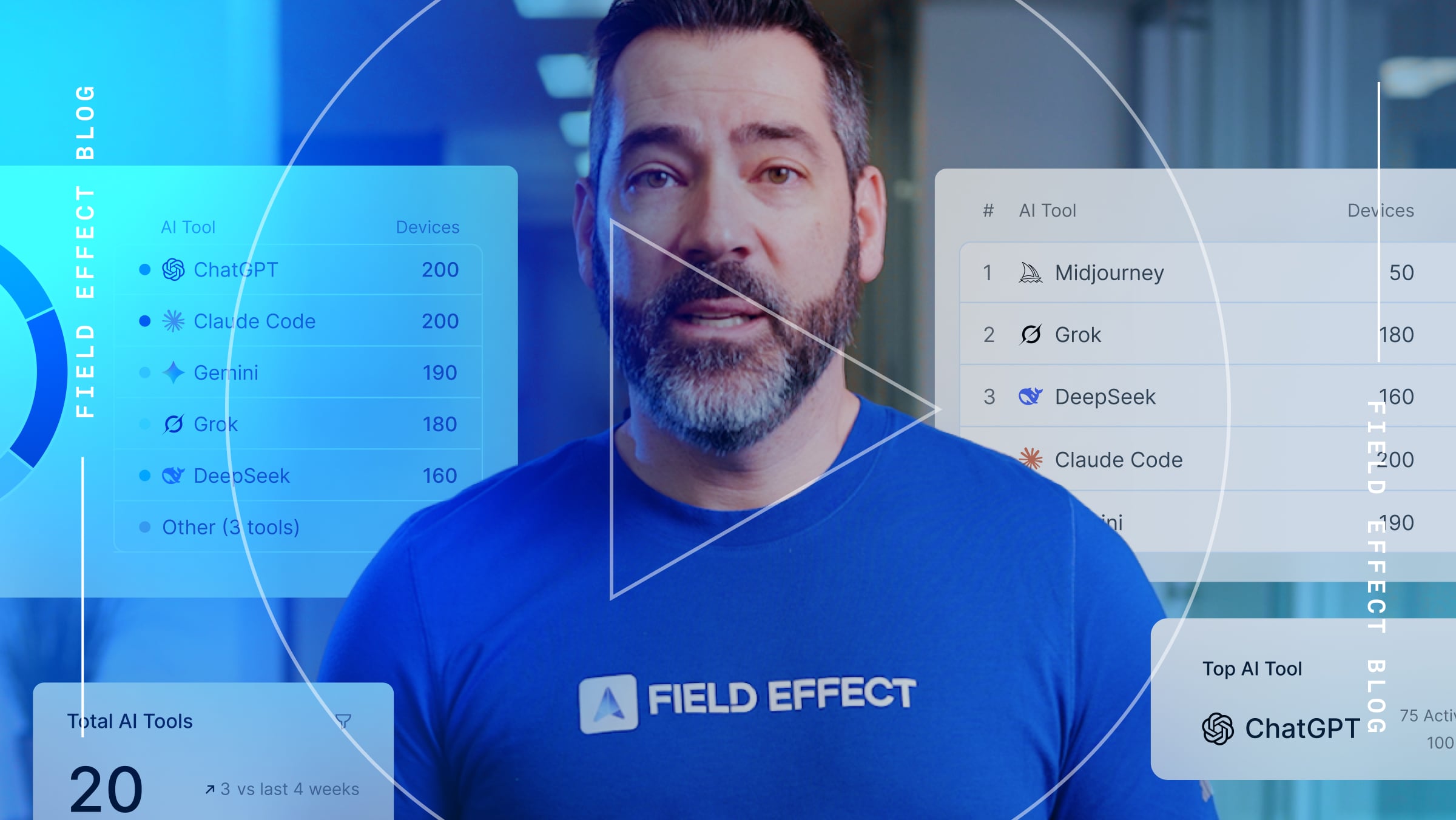
Most organizations writing AI policies today still can't answer basic questions: which AI tools are actually running across the environment, who's using them, and what data those tools can reach. Without that visibility, even a well-written policy is running on trust rather than evidence.
This is the gap Field Effect built AI Detection & Response (AIDR) to close. Rather than adding another dashboard to monitor, AIDR is built into Field Effect MDR, surfacing AI activity, flagging shadow AI, and giving security teams the controls to sanction or block tools as policy dictates.
Our founder and CEO, Matthew Holland, put it simply when we launched AIDR: AI detection and response isn't something you can bolt on as a standalone tool, it has to be built on the same visibility already securing the rest of your environment.
That's the shift AIDR represents: governance stops being a quarterly exercise built on policy documents alone, and starts being something your security stack actively enforces in real time.
The organizations that capture AI's full value won't be the ones that adopted fastest. They'll be the ones with the visibility and controls to do it safely. AIDR is how Field Effect helps make that possible.