Blog Post
Last updated: September 23, 2026
Artificial intelligence has become part of everyday business life almost overnight. Whether it’s helping draft emails, summarize long documents, or spark new ideas, AI tools are now woven into the workflows of any business looking for ways to work smarter.
But with this rapid adoption comes a new challenge that many organizations haven’t fully recognized yet: shadow AI.
Just like shadow IT before it, shadow AI doesn’t disappear when ignored. It simply becomes harder to see. And when something is hard to see, it’s even harder to secure.
Shadow AI refers to any use of AI tools, models, or agents inside a business that happens without the knowledge or approval of IT or security teams.
Most of the time, it isn’t malicious. Employees are simply trying to be more efficient, and AI tools are incredibly easy to access. A quick browser extension here, a free chatbot there, and suddenly AI is embedded in daily work in ways no one planned for.
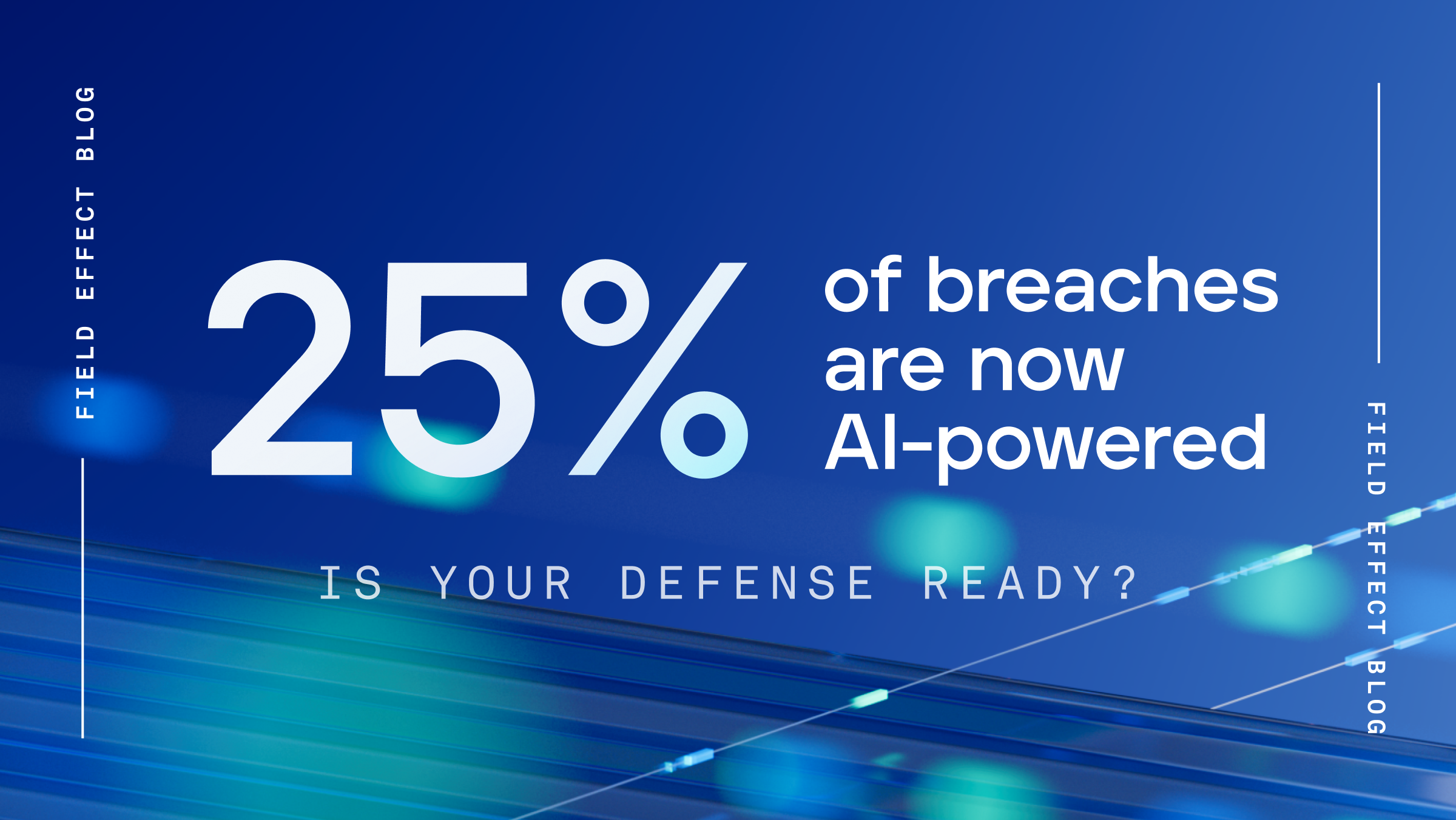
The scale of this is striking: 59% of employees admit to using AI tools their organization hasn't sanctioned.
And that's not just a self-reported number. Field Effect's own data shows how large the underlying AI footprint actually is: 94.9% of managed client organizations have detectable AI tool usage, and within that same customer base, 57.4% of clients use six or more AI tools, and 8.3% run 20 or more.
Shadow AI can take many forms. An employee might paste customer information into a public chatbot to clean up a report. A SaaS platform might quietly enable new AI features by default, sending data to third-party processors without anyone realizing it. Autonomous AI agents may start taking actions on behalf of users, interacting with internal systems in ways that aren’t monitored.
Even something as simple as a browser plugin can introduce an AI assistant that reads emails, analyzes CRM data, or stores prompts indefinitely.
One data point worth noting among Field Effect data: 88.1% of organizations have at least one user running an AI tool that no one else in the company uses. That alone isn't proof of shadow AI as there are legitimate reasons a single employee might use a specialized tool. But it's a signal worth paying attention to, and a signal you'd only have with visibility into your AI environment.
If shadow IT was a slow leak, shadow AI is a burst pipe: faster, harder to detect, and capable of moving sensitive data in ways that traditional security tools were never designed to track.
The power of AI is exactly what makes it risky when used without oversight.
Data leakage is the most immediate concern. It's incredibly easy for sensitive information (things like customer records, financial details, and internal documents) to end up inside public AI systems that store or train on user inputs. Once that data leaves your environment, there's no practical way to clean up the mess.
Compliance is another major issue. Regulations like PIPEDA, GDPR, and SOC2 require organizations to know where their data goes and who has access to it. Shadow AI creates invisible data flows and decision-making processes with no audit trail, which can quickly turn into a regulatory nightmare.
There’s also the growing challenge of AI-related supply chain risk. SaaS vendors are rapidly adding AI features into their products—sometimes quietly, sometimes as default settings—and employees often treat these additions as harmless upgrades.
What they don’t realize is that turning on a new “smart” feature can redirect company data to an entirely different AI processor or sub‑processor that was never part of the original vendor review.
This shift can introduce new data residency issues, unexpected retention policies, and even the possibility that sensitive information is being used to train external models. For leaner teams especially, the risk is amplified because a tool that was compliant last month can become a liability overnight simply because the vendor pushed an AI update.
This is where AI Detection & Response (AIDR) becomes critical. It gives organizations visibility into when approved SaaS tools suddenly start sending data to AI endpoints, allowing them to detect unexpected data flows and enforce policy before information leaves their environment.
Finally, attackers are using AI to enhance social engineering. Phishing emails are more convincing, impersonation is more realistic, and automated attacks are easier to scale. Shadow AI tools can unintentionally create new entry points for these threats.
Large organizations have the luxury of AI governance committees, legal teams, and dedicated security staff. Smaller organizations rarely have that same luxury, and that’s exactly why shadow AI can actually spread quicker in those environments.
Most lean teams rely heavily on SaaS tools, many of which now include AI capabilities that are on by default. Employees adopt AI tools because they want to get their work done faster, not because they're trying to bypass security. Without a clear AI-use policy or the resources to monitor AI activity, it becomes nearly impossible to know where data is going or how it's being used.
In short, leaner businesses are adopting AI at the same pace as large enterprises, but without the same safety net.
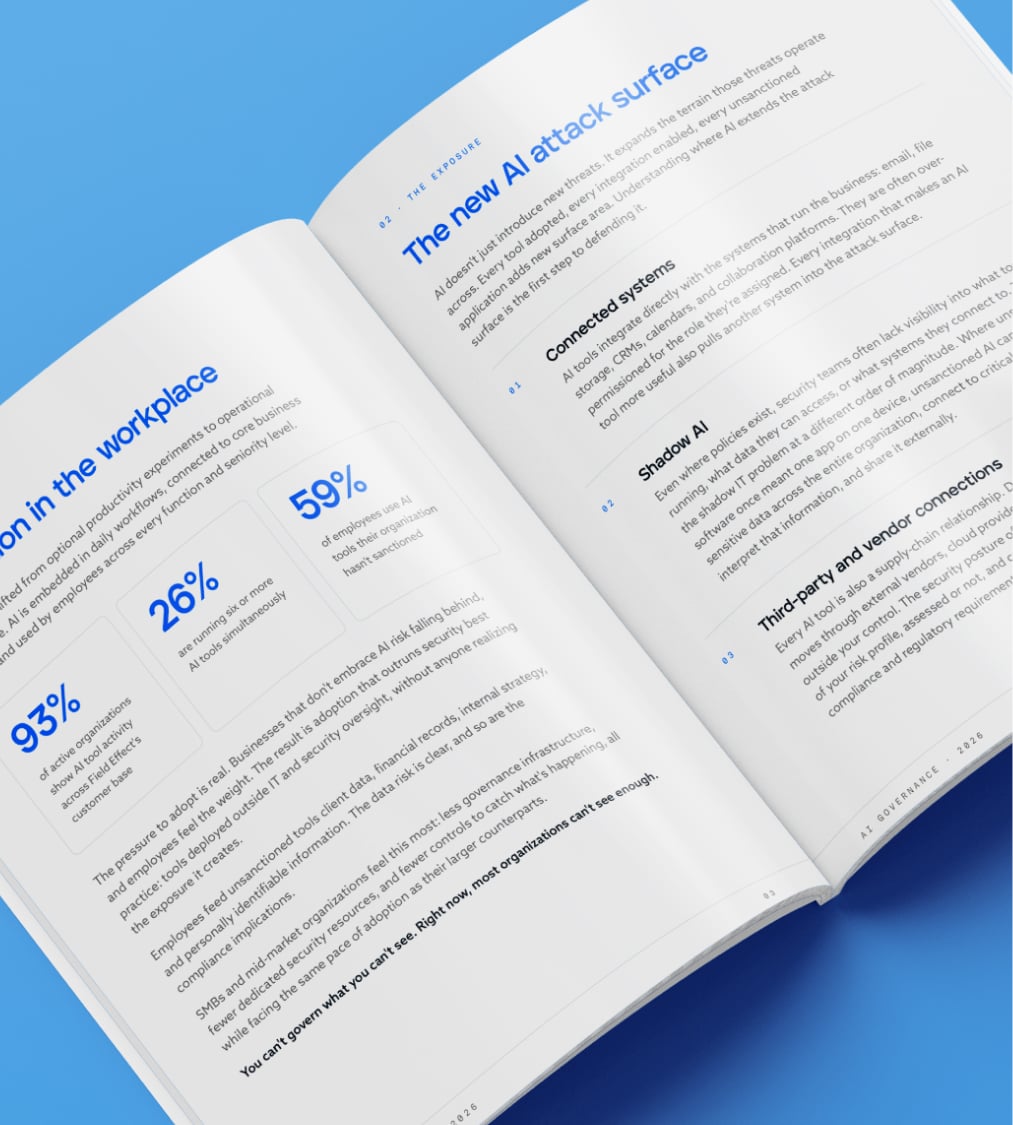
Get the controls, checklists, and policy framework to close the AI tooling blind spot, without blocking the AI your business depends on.
Shadow AI incidents don't always look like dramatic breaches. More often, they show up as subtle problems that grow over time. A customer might ask why their data appears in an AI training set. A compliance audit might uncover unapproved data flows. An employee might accidentally expose internal documents while trying to get help from a chatbot. Or an AI agent might send emails or take actions that no one authorized.
These incidents can lead to regulatory fines, breach-related costs, operational disruption, and, perhaps most damaging, a loss of customer trust.
This is where Field Effect's AIDR makes a meaningful difference. AIDR gives organizations something they've never had (or frankly needed) before: clear, real‑time visibility into and control over how AI is being used across their business.
Instead of guessing which tools employees are using or where data might be flowing, AIDR shows you exactly what's happening. It detects AI tools, agents, and extensions, even those that typically fly under the radar.
It monitors data flowing into AI systems and flags behavior that could put the organization at risk. It also identifies SaaS platforms with embedded AI features so you can understand which tools are safe and which require closer attention.
With this visibility, organizations can finally take control. AIDR helps reduce the risk of data leakage, supports compliance efforts, and provides the foundation for a practical AI-use policy that employees can actually follow. It's natively built into Field Effect MDR, giving lean teams enterprise-grade oversight without enterprise-grade complexity.
Shadow AI isn’t a sign that employees are careless. It’s a sign that they’re trying to be efficient. And with the right approach, you can channel that enthusiasm into safe, secure, and productive AI adoption.
A strong AI-use policy, clear guidance on what tools are approved, and basic training on safe prompting can go a long way. When paired with AIDR’s visibility and monitoring, these steps help create a culture where AI is used confidently and responsibly.
Field Effect data makes it clear: AI is already inside your organization. Across the vast majority of Field Effect-managed environments, dozens of tools from countless vendors are quietly at work, whether IT knows about them or not. Shadow AI isn't a future risk. It's a present reality.
AIDR gives you the visibility and control to change that. When you shine a light on what's actually running in your environment, you reduce risk and unlock AI's full potential.
Here's a look at Field Effect's AIDR: