Security Intelligence
“Attackers don’t break in anymore. They log in.”
It’s a familiar line in cybersecurity for a reason. As more work moves to the cloud, a single stolen identity can open the door to email, files, and every app connected to them.
That’s why we’re evolving Field Effect’s cloud security, and fast. In just a few weeks, we’ve rolled out three major enhancements that help organizations prevent, detect, and respond to identity attacks like never before:
Faster threat detection and response: Cloud attacks detected and contained in under two minutes
Cloud Investigation Reports: The full attack timeline, from initial access to remediation
Cloud Tenant Risk Score: Misconfigurations identified and gaps closed before attackers find them
Identity is now the #1 attack vector, and a large part of that is due to AI. The attacks themselves aren’t new, but AI has made them faster, more scalable, and more convincing.
AI can map org charts to find the right targets, research them for personalized lures, write flawless messages at scale, and even clone voices for convincing deepfakes. Work that once took a skilled attacker weeks can now take minutes. Meanwhile, ready-made phishing kits package these skills together, so even inexperienced attackers willing to pay can launch a polished campaign.
Once inside an organization, attackers are hard to detect. Without the right context, they use legitimate sign-ins and authentication flows to hide in plain sight. A single compromised identity gives them:
Sensitive data: Immediate access to files, records, and shared resources stored in cloud accounts that can be read, exfiltrated, or encrypted.
A trusted mailbox: A real employee’s inbox they can use for business email compromise (BEC), posing as that employee or a vendor to trick others into sending money or data.
A foothold for lateral movement: A working login they can use to access other systems, moving from one account or application to the next across your environment.
Stopping an identity attack takes more than spotting a suspicious login. It takes enough context to tell a real employee from an attacker using their credentials, and the ability to act the moment the difference is clear.
That context is what Field Effect MDR provides. It spans endpoint, cloud, network, and now AI, so what we learn in one part of your environment informs protection in the rest. And it's an approach we've been refining for years.
In 2018, we built one of the first Microsoft 365 and Google Workspace MDR capabilities, when business email compromise was just emerging as a priority. Since then, we've detected thousands of threat actors by identifying malicious and suspicious behavior within that broader context. When we find one, we respond automatically: ending active sessions, isolating compromised accounts, and removing malicious inbox rules.
We’ve continually evolved our defenses to stay ahead of attackers as the stakes have risen, and the surge in AI-powered attacks is no exception.
With attackers using AI to move faster, every minute between a stolen login and a response is time they can spend in your email, files, and connected apps. That's why speed is the measure that matters.
Field Effect detects and contains identity attacks in under two minutes, measured from the moment our analytics engines receive the data to the moment the attacker is locked out.
That speed isn’t an accident, Field Effect MDR was built for the AI era. We’ve spent years training our platform to reason through threats with the same context our analysts use, so the majority of threats are handled automatically. That frees our SOC to focus on the sophisticated attacks that demand human judgment and deep tradecraft.
And we keep shrinking that window. We continuously optimize our analytics and resourcing to continuously reduce the time it takes to detect malicious indicators, which leaves attackers far less time to do damage.
Stopping an attack fast is only half the job. The other half involves understanding how it happened.
Most of the time, Field Effect's AROs (Actions, Recommendations, and Observations) give you the detail, context, and guidance you need to recover from an identity attack.
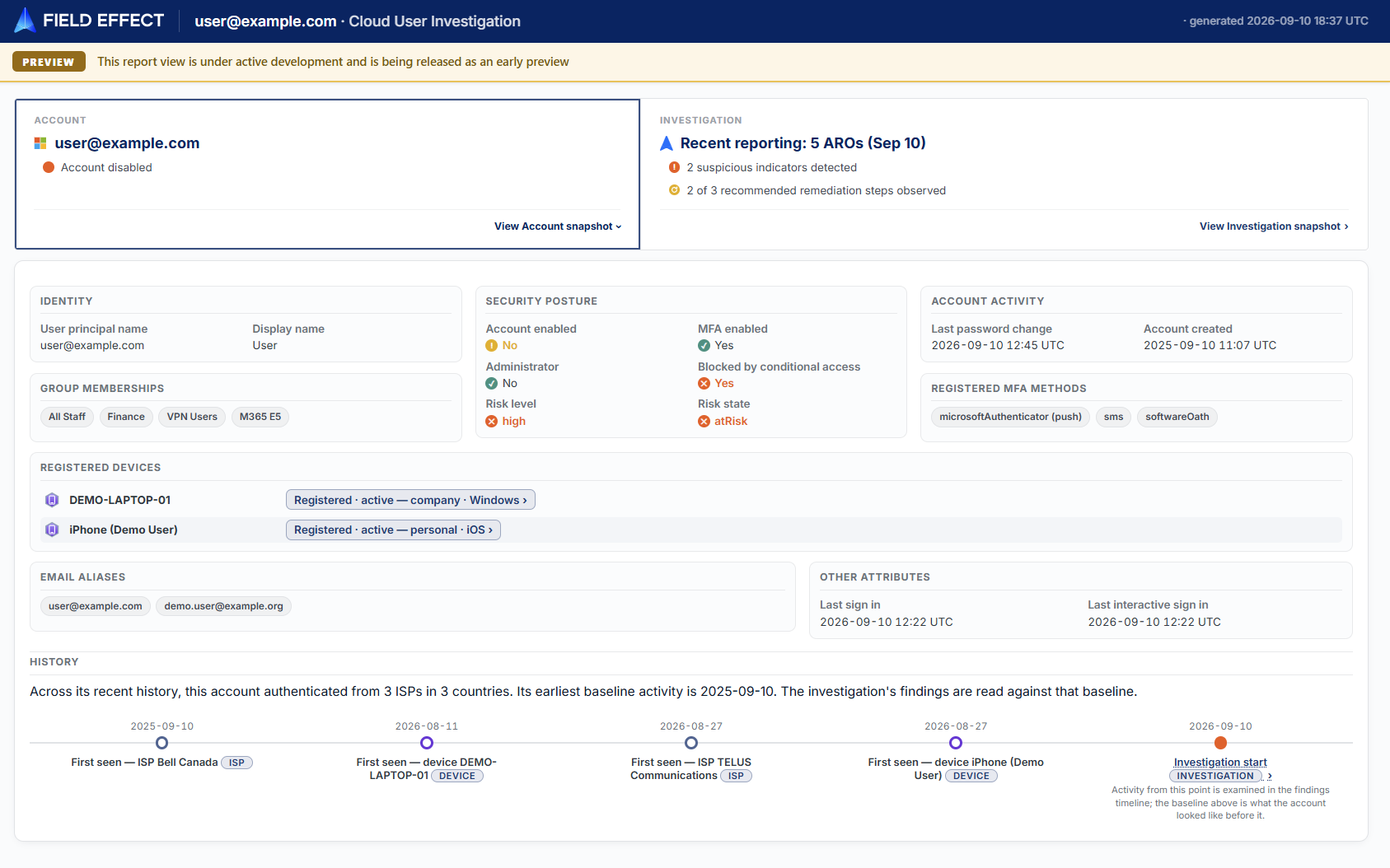
When you want the full story, the new Cloud Investigation Reports reconstruct the attack timeline with forensic-level insight into every investigation, showing:
How the attacker got in: The initial access point and the activity that flagged it as suspicious
What they touched once inside: The accounts, data, and resources involved
What's left to remediate: The actions already taken and the next steps to close the loop
When you need to go deeper, you can drill into the raw data to see why Field Effect took the actions it did, or run your own investigation. And when you need to brief leadership, a client, or an auditor, you have a clear account of what happened and why it was flagged.
Either way, you're not left piecing it together yourself.
Stopping an attack fast is good. Making sure it never starts is better.
Many identity attacks begin with a simple misconfiguration:
An overly permissive setting
A missing policy
A control that was never turned on
These gaps are easy to miss, and attackers know how to look for them.
The new Cloud Tenant Risk Score finds misconfigurations in your cloud tenant and recommends policy controls that remove attack opportunities, based on how attackers are known to exploit them. It also tracks drift, meaning changes that slowly pull your configuration away from a secure state, so new gaps don't go unnoticed.
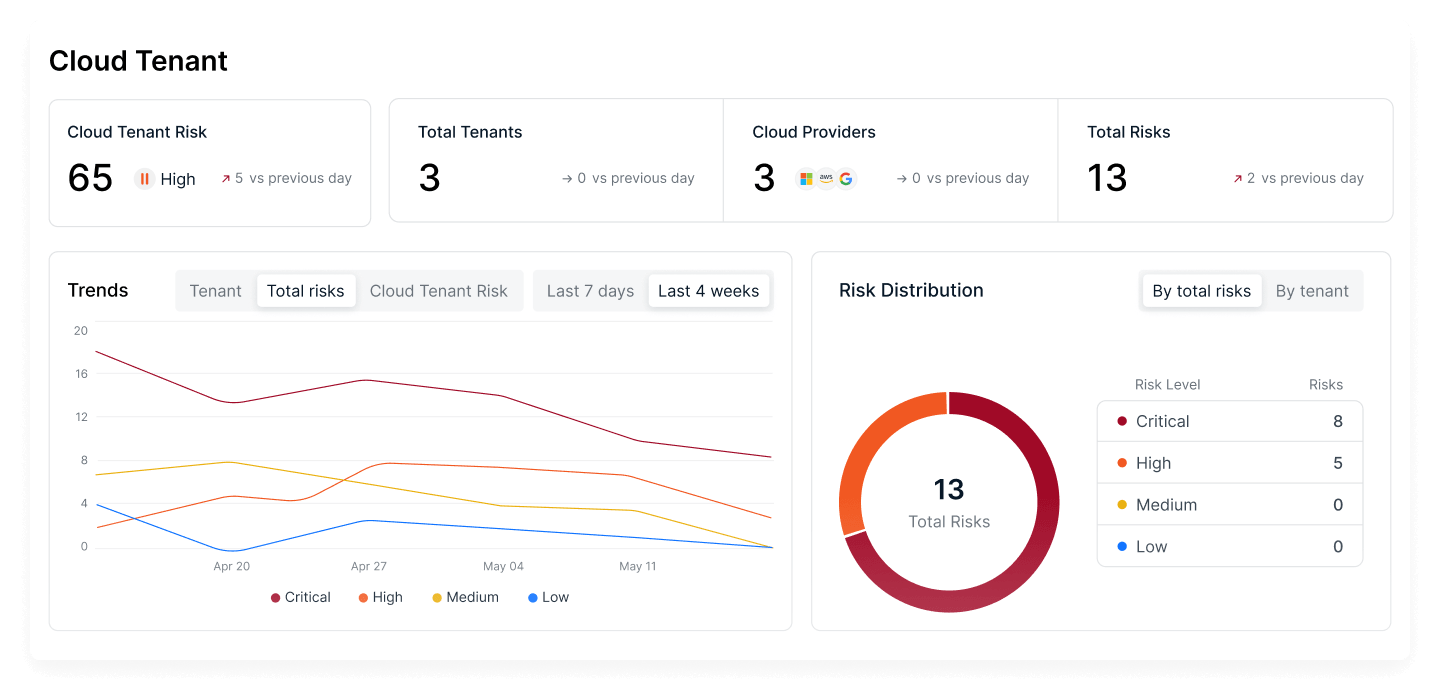
The result is full visibility into your risk and a clear view of where to act first. That's prevention in practice: reducing your exposure before an incident ever takes place.
Together, these enhancements help organizations prevent, detect, and respond to identity attacks. Faster response limits how far an attacker gets. Cloud Investigation Reports turn every incident into a clear account you can act on and share. Cloud Tenant Risk Score shrinks the attack surface before anyone tries to exploit it.
And there's more to come. These updates are the latest in a steady run of enhancements to Field Effect's identity security capability.
Identity attacks are moving faster, and so are we. Book a demo today.
Why is identity the top target for cloud attacks? Attackers increasingly log in with stolen credentials instead of breaking in. A single compromised identity can open the door to email, files, and every connected app. AI has made these attacks faster, more scalable, and more convincing, and ready-made phishing kits let even inexperienced attackers launch polished campaigns.
How quickly does Field Effect MDR detect and contain a cloud attack? Field Effect detects and contains cloud attacks in under two minutes, measured from the moment our analytics engines receive the data to the moment the attacker is locked out.
Is cloud security included with Field Effect MDR, or is it sold separately? Cloud security comes as part of Field Effect MDR, not as a separate product. One platform covers your endpoints, network, and cloud, so threats that cross between them get caught instead of slipping through the gaps. It's cloud security, and a lot more.
What happens when Field Effect finds an attacker in my cloud environment? Field Effect responds automatically by ending active sessions, isolating compromised accounts, and removing malicious inbox rules. Our SOC focuses on the sophisticated attacks that need human judgment and deep tradecraft.
What are Cloud Investigation Reports? They are forensic-level reports that reconstruct the attack timeline for an investigation. They show how the attacker got in, what they touched once inside, and what's left to remediate. You can also drill into the raw data to see why Field Effect took the actions it did, or run your own investigation.
How are Cloud Investigation Reports different from AROs? AROs (Actions, Recommendations, and Observations) give you the detail, context, and guidance to recover from most cloud attacks. Cloud Investigation Reports are for when you want the full story, such as briefing leadership, a client, or an auditor.
What is the Cloud Tenant Risk Score? It identifies misconfigurations in your cloud tenant, such as overly permissive settings, missing policies, or controls that were never turned on. It then recommends policy controls based on how attackers are known to exploit those gaps, so you can see where to act first.
What is configuration drift, and why does it matter? Drift is a change that slowly pulls your configuration away from a secure state. Cloud Tenant Risk Score tracks it so new gaps don't open up unnoticed after your initial setup.
Does Field Effect protect Microsoft 365 and Google Workspace? Field Effect built one of the first Microsoft 365 and Google Workspace MDR capabilities in 2018. That capability is now part of a single solution spanning endpoint, cloud, network, and AI.
Related Resources

Case Study

Case Study

Case Study