AI tools like ChatGPT, Claude, and Copilot are transforming the way businesses operate by streamlining workflows, improving productivity, and offering instant access to information. But their rapid adoption is also expanding the attack surface, exposing sensitive data, and creating new avenues for data leaks that often fall outside the visibility of traditional security tools.
The question isn’t whether AI can improve productivity. It’s whether organizations are compromising security in the pursuit of it.
AI adoption has outpaced governance
As AI becomes embedded into critical business workflows, the gap between adoption and security oversight continues to grow, giving attackers an opportunity to exploit.
LLMs are no longer just a tool for drafting emails or summarizing notes. They are now embedded directly into business operations, connected to CRMs, financial systems, collaboration platforms, knowledge bases, and other critical systems containing sensitive data.
Traditional cybersecurity tools weren’t built for this model. Most are designed to detect known threats or behavior that clearly deviates from expected patterns. LLMs break those assumptions. They interpret language, context, and intent dynamically, making malicious prompts difficult to distinguish from legitimate use. The same prompt can even produce different outcomes depending on context.
As organizations give, knowingly or not, AI systems access to sensitive data and internal tools, the challenge shifts from simply protecting systems to controlling how AI accesses, interprets, and shares information.
To help you kick that off, we created The AI Governance Playbook.
The hidden risks of AI adoption
Understanding the risks associated with AI tools is the first step to securing them.
Lack of visibility and control
Employees routinely share sensitive business information with AI tools, often without visibility into where that data is stored, how long it is retained, whether it is used for model training, or which third parties process it.
As data moves through external vendors, cloud providers, and APIs outside the organization’s control, it creates growing risks around privacy, compliance, governance, and security.
Over-permissioned AI tools
To maximize productivity, AI tools are often granted broad access to business systems and sensitive data, far beyond what's actually needed.
Unlike traditional applications designed for least-privilege access, many AI systems operate with minimal governance and few restrictions. If compromised or manipulated, they can become centralized gateways into critical systems and information.
Attackers don’t need direct access
Traditional attacks rely on stolen credentials or malware. LLMs change that model. Because AI systems interpret language and intent, malicious prompts can look nearly identical to legitimate requests, making them difficult to detect.
Through prompt injection attacks, attackers can manipulate how AI behaves or what information it retrieves, often without ever directly compromising a system.
Shadow AI
Employees are adopting AI tools faster than organizations can govern them. Even with AI policies in place, security teams often lack visibility into what tools are being used, what data is being shared, or what systems those tools can access.
This is Shadow IT at a completely different scale, with AI tools capable of aggregating sensitive data across the organization and unintentionally expanding the attack surface for attackers to exploit.
Until now, many of these AI tools have operated outside traditional security controls and oversight.
Now available: Field Effect AIDR
This challenge is now much easier to manage with Field Effect AI Detection and Response (AIDR):
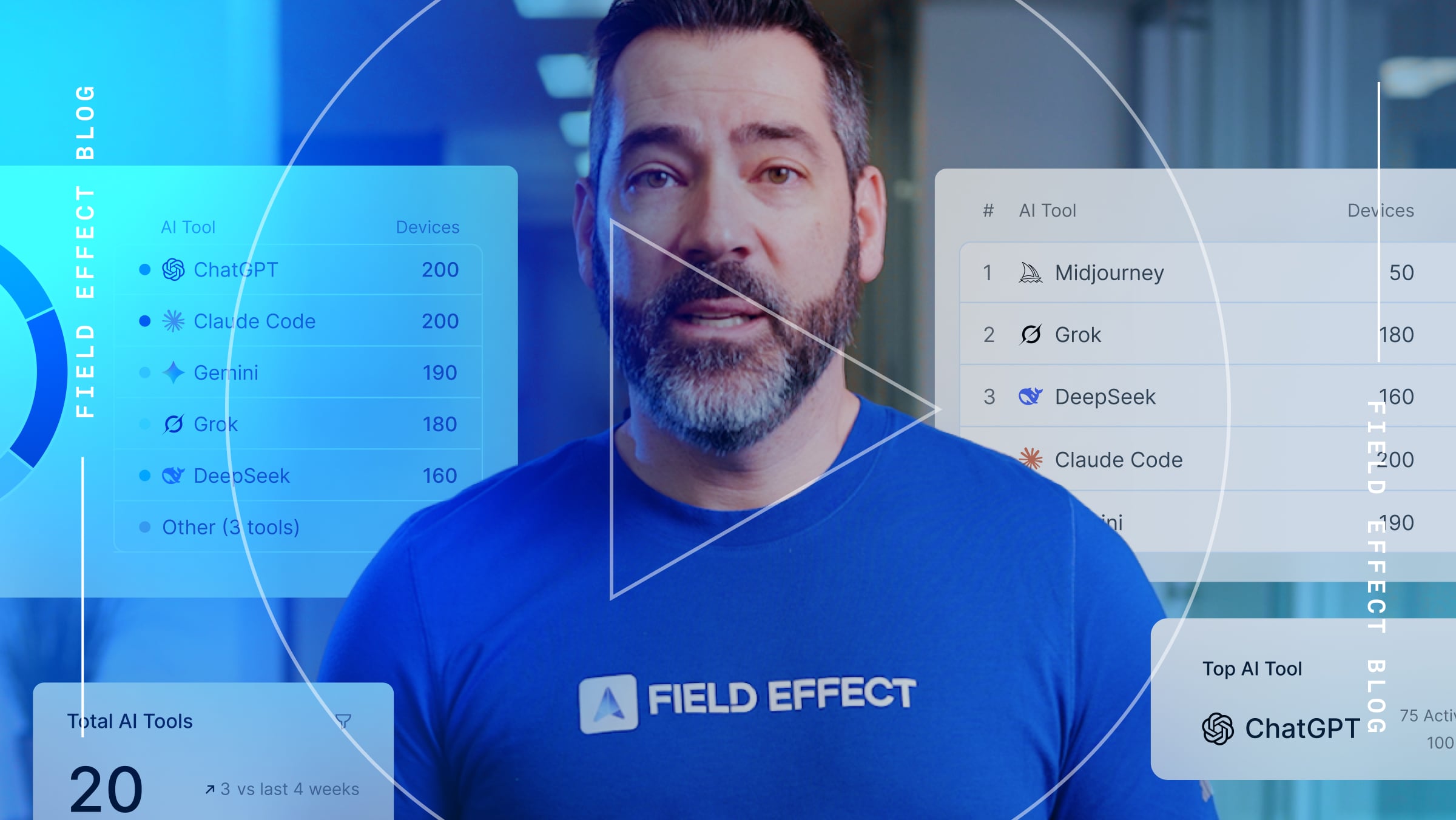
Field Effect's AIDR makes it easy for organizations to identify AI usage across their environment, including sanctioned and shadow AI tools, while achieving the context needed to understand who is using AI, what systems it connects to, and where potential risks exist.
This new capability helps organizations:
- Discover AI tools operating across the environment
- Detect unauthorized or risky AI usage
- Understand how AI interacts with sensitive systems and data
- Establish governance and reduce exposure
Cybersecurity without compromise
AI is rapidly becoming embedded into everyday business operations, and organizations can’t afford to ignore the security risks that come with the productivity gains. The challenge is enabling AI securely, with the visibility and controls needed to reduce risk without slowing innovation.
Field Effect AI Detection and Response is designed to help organizations close that gap by bringing AI usage out of the shadows and giving security teams the insight needed to protect the business while enabling productivity.
Frequently asked questions
How do AI tools expand the attack surface?
AI systems can turn every connected dataset, application, integration, and workflow into a potential entry point for attackers. Risks grow even further when employees use unsanctioned shadow AI tools outside IT visibility.
What is prompt injection and why should I care?
Prompt injection is an attack where malicious instructions are embedded into inputs that an AI system processes. Because LLMs interpret language and intent rather than following rigid rules, a well-crafted prompt can manipulate the AI into retrieving, sharing, or acting on information it shouldn't, often without triggering traditional security alerts.
What is shadow AI?
Shadow AI refers to AI tools employees adopt and use without organizational oversight or approval. Similar to Shadow IT, but with higher stakes: AI tools can aggregate sensitive data across the business, connect to critical systems, and share information externally, all outside the visibility of your security team.
Are tools like ChatGPT, Claude, and Copilot a security risk?
Not inherently, but their rapid adoption often outpaces the governance needed to use them safely. The risk isn't the tools themselves; it's how they're deployed, what data they can access, and whether your organization has visibility into how they're being used.
How is AI different from traditional security threats?
Traditional security tools are designed to detect known threats or abnormal behavior. AI systems break those assumptions by interpreting language dynamically, meaning malicious inputs can look identical to legitimate ones, and the same prompt can produce different outcomes depending on context.
What does "over-permissioned AI" mean?
Over-permissioned AI tools have been granted access to more data and systems than they actually need to function. This is common because organizations prioritize productivity over least-privilege principles. If one of those tools is compromised or manipulated, it can become a gateway into your most sensitive systems.
What is Field Effect AI Detection and Response?
It's a new capability from Field Effect that gives organizations visibility into AI usage across their environment, including shadow AI, so security teams can understand who is using AI tools, what systems they connect to, and where risks exist. The goal is to enable AI securely, without slowing down productivity.